Southall Stories · Preliminary findings · Updated November 2026
What we were told, and what we recorded
Between 2017 and 2019, residents near the former Southall gasworks complained about the smell and about how they felt. They were told many things in reply, by the developer, the council and the agencies. Some of it was repeated as late as 2021. This page sets what they were told against what has since come to light: the authorities' own answers, the residents' record, the hourly wind and the developer's monitoring.
What the authorities say now
In October and November 2026 we put our findings to Berkeley, Ealing Council and the UK Health Security Agency (UKHSA), which took over from Public Health England (PHE), and made information requests to the Environment Agency. Four answers stand out.
Berkeley, letter to the leader of Ealing Council, 28 June 2021
The works “have been completed and approved by Public Health England, the Environment Agency and LB Ealing's Environmental Health”.
UKHSA, 3 November 2026
“No. PHE did not have a regulatory role in relation to the remediation works.”
We asked Berkeley whether it still says PHE approved the works. It did not reply. Its statement to us says only that the works were “approved by the authorities, including Ealing Council and the Environment Agency”.
Berkeley, same letter
Ealing's environmental team and Public Health England “have sufficient powers to investigate and to stop works”.
UKHSA, 3 November 2026
PHE “did not have powers to stop the development”.
And the council leader had told residents in July 2018 that there was “a high bar that has to be breached in law” before the council could act. Who was in charge?
Atkins, relayed by PHE, April 2019
Trichloroethene readings of up to 475 µg/m³ in the park were likely from road asphalting or off-site tarmac plants.
Environment Agency, 6 November 2026
It holds no record of any investigation of the readings.
UKHSA says PHE “were not provided with details of the past land use”, which “would include trichloroethene in groundwater”. The developer's own 2016 assessment had found it there. The readings
Ealing Council, statement to us, 29 October 2026
“The new analysis relates to historical data from the author.”
What the data are
The developer's own laboratory results, released by the council itself in 2019.
In November 2026 UKHSA released PHE's own spreadsheet of the same results. Wherever both can be read, it matches our extraction: 7,634 values from 694 tubes, differing only in rounding. We pointed out the council's error on 29 October. It has not replied.
Of the twenty-two statements residents were given, checked against the record. See them all.
On camera · 10 July 2019 · Air quality meeting
“We know that there was a problem with odour … we've all smelt it.”
The council “recognises it was a nuisance, frankly … and a bad nuisance”. Julian Bell, then Leader of Ealing Council. A year earlier his officers had reported they could not detect odour beyond the site boundary “to any great extent”. Full meeting video
Who was in charge?
Four organisations were involved: the developer, the council, the Environment Agency and Public Health England. Each, when asked, pointed somewhere else. Here is how responsibility was passed around, in their own words, from 2017 to this month.
Berkeley developerEaling planning authority; nuisance lawEA environmental permitsPHE health advice, now UKHSA
25 Jul 2017
Ealing→EABerkeley
Replying to residents of Beaconsfield Road, the council's principal pollution officer said the treatment plant's permit conditions “ought to be monitored and enforced by the EA”, that the council was “liaising with the EA to identify which team is currently monitoring compliance”, and that residents should ring the Agency's hotline. Cleaning the dust from their homes and cars was “a matter which the Council has no jurisdiction on and which should be discussed directly with the developer”.
6 Jul 2018
Ealing→Berkeley
Residents who complained to the council leader were told to complain to the developer: Berkeley “requested residents should report this to: Southall Waterside community relations team”, with its freephone number.
12 Jul 2018
Ealing→the law
“There is a high bar that has to be breached in law before a local authority can take that action.” While Berkeley was co-operating, “it is hard to demonstrate that this bar has been breached”.
27 Jul 2018
Berkeley→EAEaling
The Environment Agency and Ealing's environmental health officers “are satisfied that we are within the permitted odour levels”. We have found no permitted odour level.
Aug 2018
EA→no one
It told a resident it had no grounds to require the operator to stop. Its officers told the council's scrutiny panel it “did not have the powers to ask the developer to cease operations”, which “would require a slow legal process”.
Oct 2018
PHE→Ealing
It described itself as advising Ealing Council, at the council's request.
19 Feb 2019
Berkeley→PHE
“The position as regards health has now been put beyond doubt by Public Health England.” A month later PHE said naphthalene levels “should urgently be reduced”.
7 Jun 2021
Ealing→EA
The new council leader: “Land remediation, being regulated by the Environment Agency, perhaps did not focus high enough in the 2017-22 plan.”
28 Jun 2021
Berkeley→EalingPHE
If its works were causing a problem, the council and PHE “have sufficient powers to investigate and to stop works”.
Sep 2026
EA→not its remit
On the verification of the clean-up, it had “no formal comment to make, as the application falls outside of its remit”.
21 Oct 2026
Berkeley→EalingEA
The remediation “was closely monitored and approved by the authorities, including Ealing Council and the Environment Agency”.
29 Oct 2026
Ealing→PHE
“Air quality monitoring was in place during the works and we commissioned Public Health England to independently assess the monitoring data.”
3 Nov 2026
UKHSA→EalingEA
PHE “did not have powers to stop the development”. Questions about the monitoring should go to Ealing Council or the Environment Agency, “who both regulated the development”.
Thirteen passes. Berkeley pointed to the regulators four times; Ealing pointed elsewhere five times; the Environment Agency twice said it had no power or no remit; PHE and UKHSA twice pointed back to the council. In the record we hold, none of the four has said that stopping the works, if the smell warranted it, was its job.
The full record, body by body
Who
When
What was said or recorded
Ealing Council planning authority; nuisance law
2016
The approved site-wide construction plan monitors dust only. It sets no odour or vapour monitoring and no level at which work would stop, although Condition 12 required “monitoring and suppressing dust, vapours and odours”. The council relaxed Condition 17 so that homes could be built while remediation continued.
Jul 2018
The council leader, Julian Bell, wrote to residents on 12 July: “there is a high bar that has to be breached in law before a local authority can take that action” (an abatement notice). While Berkeley was co-operating, “it is hard to demonstrate that this bar has been breached”.
Jun 2021
The new leader wrote: “Land remediation, being regulated by the Environment Agency, perhaps did not focus high enough in the 2017-22 plan.” Independent monitoring was to be paid for by Berkeley, capped at £200,000.
Jul 2021
Counsel advised that the council “must review its investigative and evidence gathering approach”.
Oct 2026
“Air quality monitoring was in place during the works and we commissioned Public Health England to independently assess the monitoring data.”
Environment Agency environmental permits
2017
It recorded odour from the soil treatment facility in October, November and December as “Containment and Control Failure”.
2018–19
The council's scrutiny panel recorded its officers' evidence. The contractor's mobile plant permit “would not be renewed as not enough controls were in place”. The Agency “considered that no significant controls to prevent odours from escaping from the site were in place”. It “did not have the powers to ask the developer to cease operations”, which “would require a slow legal process”.
Jan–Jun 2019
Its incident notes say the contractor “submitted an incorrect environmental permit application type”, which was “returned to the applicant”. The soil hospital was decommissioned at the end of March 2019.
Sep 2026
On the verification of the remediation (Condition 38), it had “no formal comment to make, as the application falls outside of its remit”.
Nov 2026
It holds no record of any investigation of the April 2019 trichloroethene readings.
Public Health England / UKHSA health advice to the council
2018–20
It assessed the monitoring data “made available to it”, at Ealing's request. It was “not provided with details of the past land use”.
Nov 2026
“PHE did not have a regulatory role in relation to the remediation works and did not have powers to stop the development.” It said Ealing Council and the Environment Agency “both regulated the development”.
Berkeley / St James developer
2016
Its consultant's remediation strategy promised monitoring “to ensure investigation/action levels are not exceeded”. We have not found those levels.
2018
It told the scrutiny panel there were “no formal scores for odour complaints that would trigger a decision to stop”.
Jun 2021
Ealing's environmental team and PHE “have sufficient powers to investigate and to stop works”. The works had been “approved by Public Health England, the Environment Agency and LB Ealing's Environmental Health”.
Oct 2026
The remediation “was closely monitored and approved by the authorities, including Ealing Council and the Environment Agency”.
Twenty-two statements
What residents were told from 2017 to 2021, each set against what the record shows. Open “What the record shows” under any statement for the evidence and sources.
Showing six highlights. Choose All or a verdict to see the rest.
On camera · 8 July 2020 · Protest at the Tudor Rose
“When I come to work, I can smell that every single day I come.”
“If you look at what's going on in Southall already, we've got big problems. Right down back by the gas works … We've got serious, serious problems that's going on.” A local resident, speaking at a protest outside the Tudor Rose. Full protest video
The record, month by month
The statements above were made against this background. It shows odour reports held in the residents' record, by month. The darker part of each bar is reports that also mention symptoms such as nausea, headaches or a sore throat. Marks along the top are the 2017–19 statements below, coloured by what the record shows.
Odour reportsWith symptomsNo source coded for these monthsStatement (colour shows what the record shows)
Counts show what was written down and kept, not how often the smell occurred. Shaded months have no coded source. People reported less when they felt nobody was listening.
Why all at once?
The whole site was dug up and its soil treated in the open, in one place, over about two and a half years. Berkeley has given three different reasons.
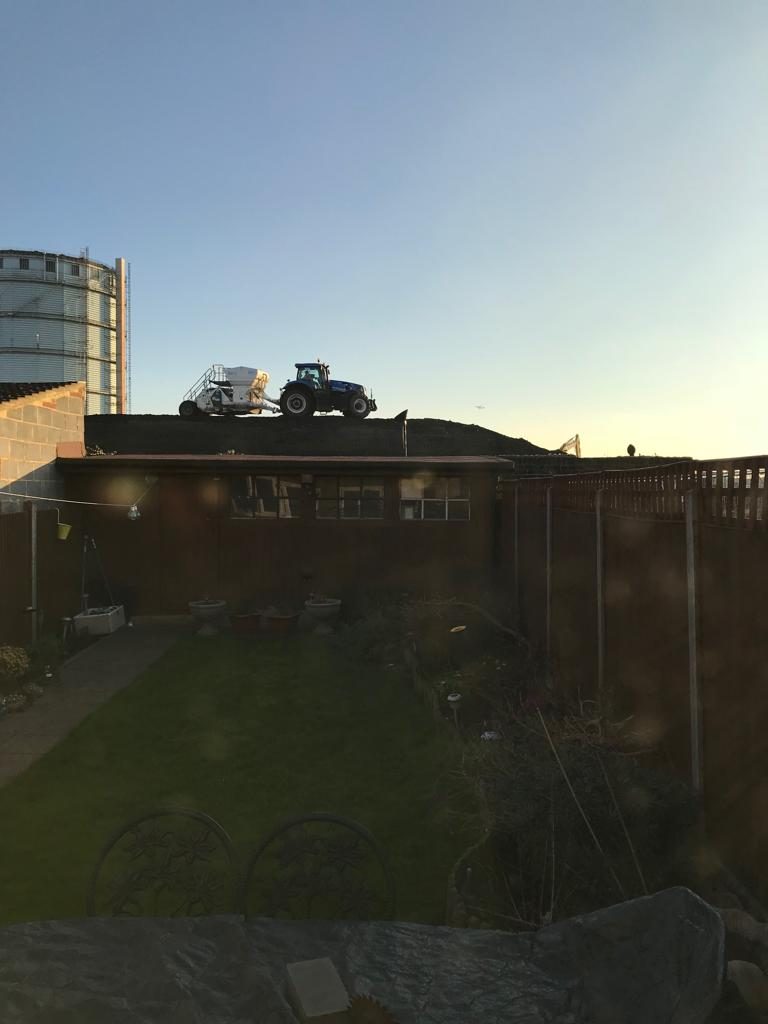
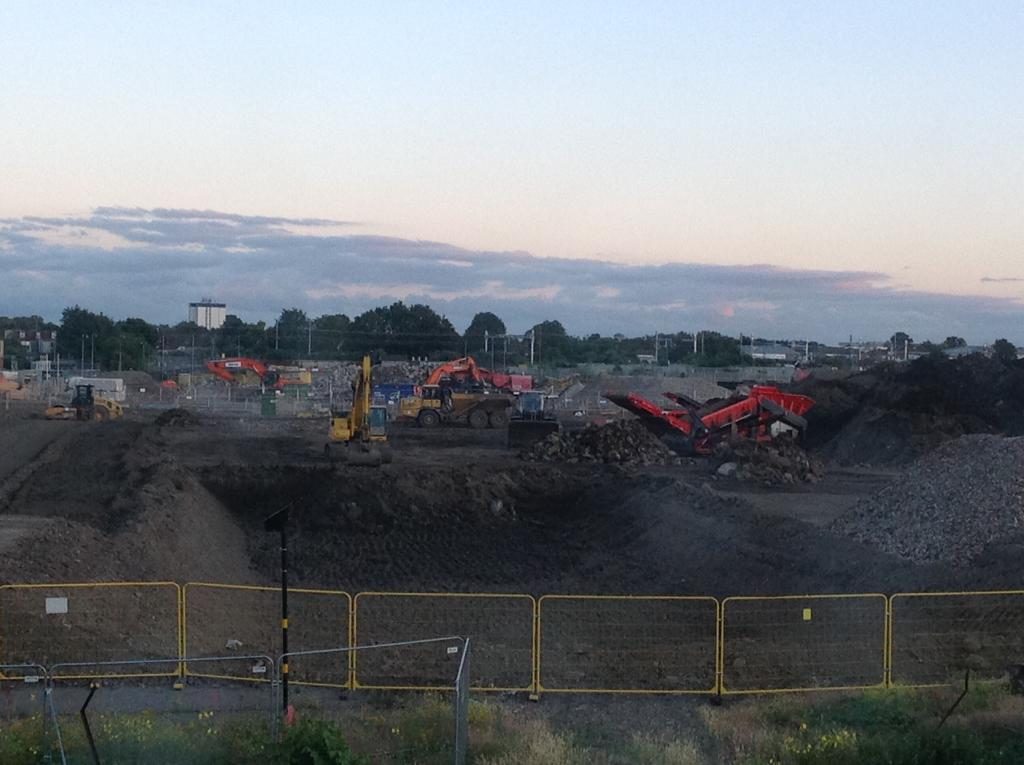
An uncovered soil stockpile on the site, seen over a neighbour's back fence, February 2018.Open excavation, June 2018, the month residents logged the most odour reports.
Photos shared among residents.
2015
A necessity
At the public inquiry into the compulsory purchase of land for the scheme, St James, part of the Berkeley Group, said the site “has to be remediated as a whole”, working with the groundwater flow, or “coal tar would spread through the groundwater and re-contaminate remediated areas”.
Remediating and developing only part “would not be financially viable”. The inspector added that, so close to the Crossrail station, “a partial redevelopment would be a waste”.
2016–17
A time saving
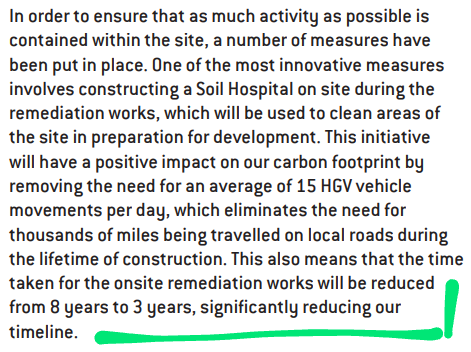
Berkeley's first newsletter to residents said the on-site soil hospital would cut lorry trips and reduce the remediation “from 8 years to 3 years, significantly reducing our timeline”.
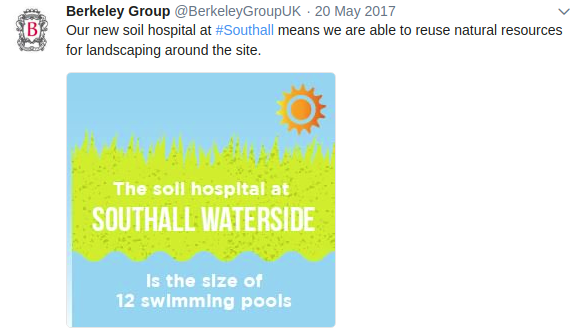
In May 2017 it announced the soil hospital on social media as “the size of 12 swimming pools”. The first complaint in the residents' record came that month.
The post was later removed. Berkeley's July 2017 press release said “12 Olympic swimming pools”.
2021
A favour to neighbours
Berkeley told Ealing's new leader that the approved strategy allowed phased remediation “forecast to take until 2038”, and that it chose to work early “to minimise the long term impact on our neighbours”.
What every version leaves out is the trade-off: fewer lorries and a shorter programme, against treating the contaminated soil of a 3,750-home site in the open, beside homes, for about two and a half years. Those are the years in which almost all of the residents' reports were made. We have found no assessment of that trade-off, and no sign that residents were asked.
On camera · 19 May 2023 · The Queen of the Suburbs
“… many, many terrible smells and certainly some bad chemicals released into the environment.”
Regulators' view that the works had not had a detrimental impact on health “is not the sentiment that's experienced by the community”. Peter Mason, Leader of Ealing Council and councillor for Southall Green, two years after Berkeley's letter told him the works would not harm anyone. Full 14-minute video (clip near the end)
Homes first, Crossrail close by
The timetable for the site was set against the arrival of Crossrail, now the Elizabeth line, from the start.
2011
Under National Grid, the site is to be “developed in stages between 2012/13 and 2027/28”.
Dec 2013
The Mayor's office: first homes “anticipated to complete in 2019, the year after Crossrail opens”.
2014
The planning framework calls Southall one of three places in London “best positioned to secure the wider economic benefits that Crossrail is intended to deliver”. Berkeley's annual report: the gasworks is “adjacent to a Crossrail station due to open in 2019”.
Jan 2016
Compulsory purchase confirmed. The permission includes “the demolition of 22 houses”, on The Crescent and Randolph Road, for an access road. “Potential pollution from remediation works” was among the main objections.
Apr 2016
Homes before the clean-up is finished. Ealing relaxes the condition that all remediation be complete before development, so that 425 early homes can be delivered by November 2018: “accelerated delivery of housing”.
2016
Berkeley: the first phase's “affordable housing will be delivered ahead of the private units”.
May–Jul 2017
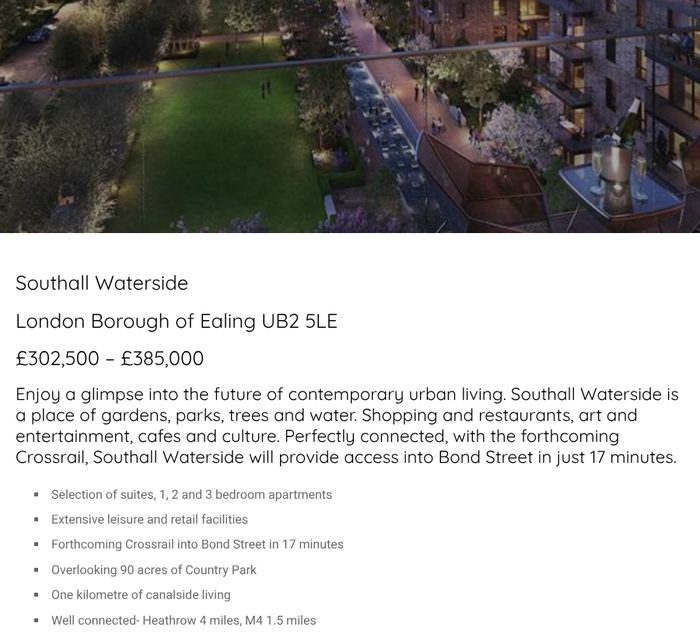
The soil hospital opens. Agents are already listing flats from £302,500, citing the “forthcoming Crossrail into Bond Street in 17 minutes”.
2018
Berkeley's annual report: “international investment plays a pivotal role in generating the early security of future cash flows and momentum to commence construction”.
2019
The soil hospital closes in March. The first homes are “offered to Ealing residents on an affordable rent or shared ownership basis”.
Jun–Jul 2020
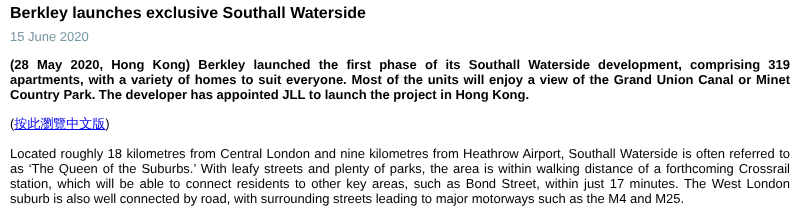
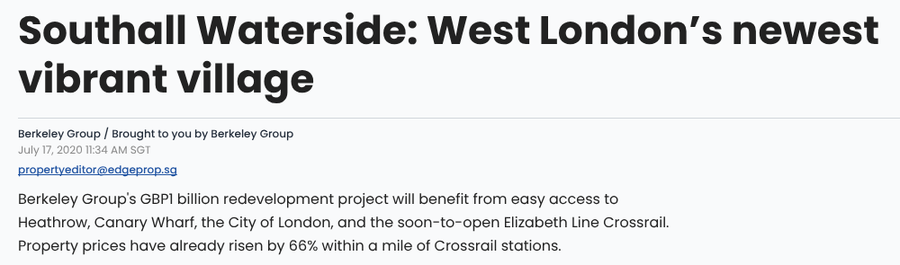
Sold abroad first. The first 319 private flats are launched in Hong Kong and Singapore, before the UK launch “later this year”. The Singapore promotion points to “the soon-to-open Elizabeth Line Crossrail”.
May 2022
The Elizabeth line's central section opens.
London agent, July 2017, two months after the soil hospital opened.Hong Kong launch through JLL, June 2020.Singapore, July 2020: “Brought to you by Berkeley Group”.
None of Berkeley's annual reports or results statements from 2014 to 2020 mentions the odour, residents' complaints or Public Health England. We have found no Berkeley statement that links the remediation timetable to Crossrail or to sales. The documents show what was decided and how the homes were sold, not why.
Next door, done differently
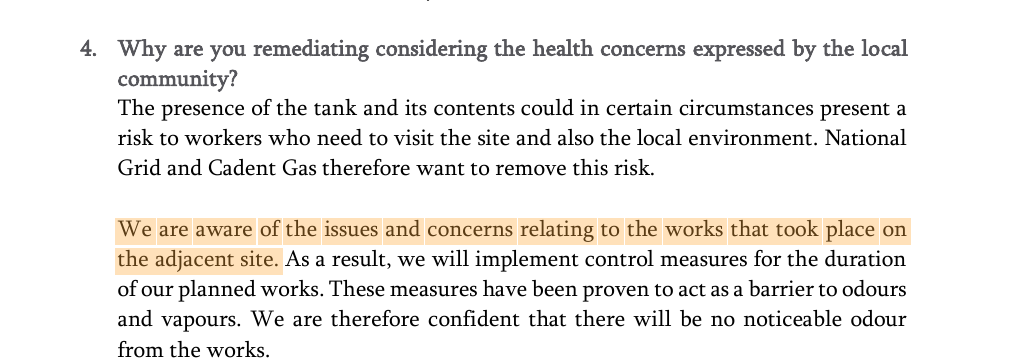
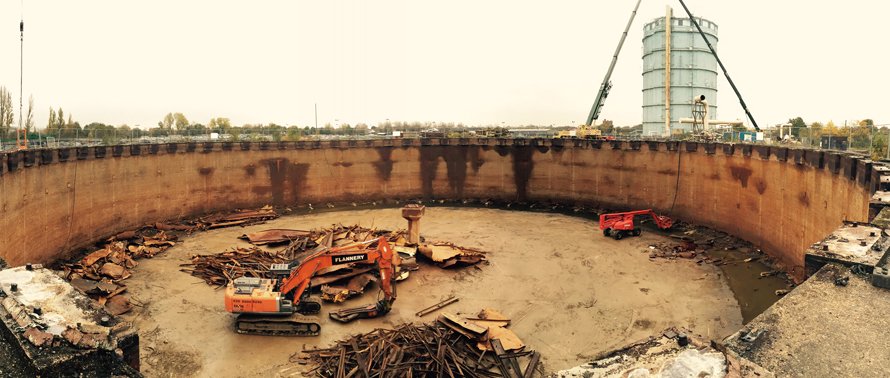
In 2020 National Grid returned to the gasholder land in the middle of the site, owned by Cadent, to dig out an old underground tank and the soil around it. Its information sheet for residents began by acknowledging what had happened next door:
National Grid, “Southall Gasworks – Environmental Improvement Work FAQ”, 2020, question 4. The “adjacent site” is the Berkeley remediation.The base of a dismantled gasholder on the National Grid land, before the tank was dug out. From National Grid's project website, southallgasholders.com, as archived in February 2018.
Soil hospital, 2017–19
Open-air excavation and treatment
Treated soil stored and reused on site
Started in May, ran through two summers
No odour or vapour level at which work would stop
Residents told the smell was not a health risk
National Grid, 2020–21
A steel enclosure over the whole dig; air “put through a treatment system to remove vapours, odours and dusts prior to release”
“We will not be treating or storing any contaminated soils on site”: sealed lorries to Redhill or Peterborough
Started in the cooler months, “to further facilitate maximal control of odours”
“Should levels exceed permitted levels we will cease work”
The smell is “hydrocarbons, tars and ammonia”, some of which “may be harmful if inhaled in high concentrations over a prolonged period”
The enclosure went up in November 2020, the dig ran from January 2021 and the enclosure came down in February 2021. A second stage, from 2023, pumped tar-like liquids out of the groundwater “via a bespoke, sealed system”.
The comparison has limits. National Grid's dig was less than a tenth of the size of the Waterside remediation, and it said the smaller scale is what made an enclosure possible. But it shows what was available, and what a neighbour on the same site chose to do once residents had complained.
How we asked
On 20 October 2026 we sent Berkeley Group, Ealing Council and UKHSA the findings that concern them, with specific questions and a deadline of 5pm on Friday 30 October. Here is what they said, and what they did not. Updated 15 November 2026.
Berkeley Group
0 of 9 questions answered
Asked 20 Oct · replied 21 Oct, through its PR firm, Brunswick · follow-up unanswered
“The remediation of this site, which is now complete, was a highly regulated process, which was closely monitored and approved by the authorities, including Ealing Council and the Environment Agency.”
Why it matters. In June 2021 Berkeley told the council leader the works had been “approved by Public Health England”. UKHSA has now said PHE did not approve them and had no power to stop them. We asked Berkeley whether it still stands by its 2021 claim, and what the Environment Agency actually approved. It did not reply.
The nine questions it did not answer
why the whole site was remediated at once, given Berkeley's 2015, 2016 and 2021 accounts;
whether the timing of Crossrail or of sales played a part;
why no odour or vapour level was set at which work would stop;
whether enclosing the soil hospital was considered;
which “legal limits” residents were told about in September 2018;
why tube monitoring began only in June 2018;
whether the 2017–19 monitoring data and complaint records will be published;
whether the vapour target and intervention levels promised in 2016 were set or exceeded;
who wrote a 2023 consultation report's description of residents.
Ealing Council
answered in general terms only
Asked 20 Oct · replied 29 Oct · follow-up unanswered
“During the remediation, we were guided by the evidence and independent expert assessments undertaken in relation to the site. The new analysis relates to historical data from the author.”
Why it matters. It does not. The monitoring results are the developer's own laboratory reports, which the council itself released in August 2019. The wind data are Met Office records. Only the odour reports come from residents. PHE's own spreadsheet, released by UKHSA in November, matches our extraction wherever both can be read, differing only in rounding. We told the council on 29 October; it has not corrected the statement.
The full statement, and what it did not answer
“We recognise residents’ concerns about odours during the 2017-2019 remediation of the former Southall Gasworks site.
“Air quality monitoring was in place during the works and we commissioned Public Health England to independently assess the monitoring data. Its assessment found that the results indicated there was unlikely to be a direct toxicological risk to the health of nearby residents, while recognising that odours can cause short-term symptoms such as nausea, headaches and dizziness.
“We sought legal advice in July 2021, which confirmed that we were appropriately discharging our statutory duties under the Environmental Protection Act 1990, and associated legislation. Recommendations were made for additional monitoring, and although these additional actions were beyond the scope of the council’s legal duties, we committed to, and delivered, those actions.
“During the remediation, we were guided by the evidence and independent expert assessments undertaken in relation to the site. The new analysis relates to historical data from the author.”
The press office added that more detailed information could be requested through the council's freedom of information channel. We have done so: see the requests below.
Partly answered: which of counsel's 2021 recommendations were carried out (“those actions”, not specified).
Not answered: whether the council will review its conclusion on the source of the odour in light of the wind analysis; whether a vapour and odour monitoring scheme was approved under Condition 12; whether it received the vapour target and intervention levels promised in 2016; why it holds no complete copy of the approved Phase B construction plan; whether it assessed the effect on neighbours when relaxing Condition 17; whether it agrees that it had powers to stop the works; whether it will release its 2017–19 odour complaint log.
On 29 October we asked who paid for the additional monitoring: the council leader's letter of 7 June 2021 says Berkeley agreed to fund independent monitoring, capped at £200,000, before counsel advised. There was no reply.
UK Health Security Agency
5 of 5 questions answered
Asked 20 Oct · replied 3 Nov, after a reminder
Approval and powers. “No. PHE did not have a regulatory role in relation to the remediation works and did not have powers to stop the development.”
The solvent. PHE “were not provided with details of the past land use which would have indicated the likely chemicals present on site … This would include trichloroethene in groundwater.”
The data. UKHSA “did not undertake the monitoring or laboratory analysis and was provided records for the site by Ealing Council”, which, with the Environment Agency, it says “both regulated the development”.
Where we were wrong. “The soil hospital area was not excluded from PHE's assessment.” Residents nearest it were assessed separately. Our question implied otherwise; UKHSA is right, and we have corrected the page.
The full statement and all five answers
“Public Health England (PHE), whose health protection functions transferred to the UK Health Security Agency (UKHSA) in October 2021, was asked by Ealing Council to independently review air quality monitoring data relating to the Southall Waterside development and provide public health advice.
“PHE's role was to assess the potential public health implications of the air quality monitoring data made available to it. It did not regulate, manage, or supervise remediation works at the site.
“PHE reviewed air quality monitoring data around the Southall Waterside development and published a series of health risk assessments. While some chemicals, including benzene, showed intermittent exceedances of assessment levels, PHE concluded that the available monitoring data indicated that there was unlikely to be a direct toxicological risk to the health of the nearby population from the levels detected and recommended that mitigation measures and monitoring continue.”
Trichloroethene in groundwater. PHE “were not provided with details of the past land use which would have indicated the likely chemicals present on site … This would include trichloroethene in groundwater.”
The soil hospital. “The soil hospital area was not excluded from PHE's assessment.” Residents nearest it “were assessed separately using the five monitoring stations nearest to that area”.
The 56.3 µg/m³ benzene certificate. UKHSA “did not undertake the monitoring or laboratory analysis and was provided records for the site by Ealing Council”. It suggested an information request to Ealing Council or the Environment Agency, “who both regulated the development”.
Powers and approval. “No. PHE did not have a regulatory role in relation to the remediation works and did not have powers to stop the development.”
Assessment today. UKHSA keeps methods under review. PHE's assessments “recognised that some individuals may be more susceptible to certain chemicals, including people with glucose-6-phosphate dehydrogenase (G6PD) deficiency.”
Information requests
Status on 11 November 2026. Requests made through WhatDoTheyKnow are public there.
Answered 11 Nov: PHE's data workbook and two Atkins technical notes released; no other records held on the trichloroethene readings or the TPH exceedances
How this was checked
The residents' record is coded from e-mails to officials (2017–19), posts in a residents' group (Feb–May 2019), a neighbourhood forum (2017–18), the author's tweets and a 2018 questionnaire. About 380 dated observations. Residents are pseudonymised. No names, addresses or individual health details are published.
Wind is the hourly record at RAF Northolt, checked against Heathrow. "Wind from the site" means within 67.5° of the bearing from the site to the reporter, at 2 km/h or more.
Monitoring figures come from the developer's Chemtest results, released by Ealing Council in 2019 and analysed on the air monitoring page. In November 2026 UKHSA released Public Health England's own data workbook. Wherever both can be read, its values match our extraction (7,634 values from 694 tubes), differing only in rounding.
What this cannot show. Reports are self-reported and come from people who chose to complain. They show where and when the smell was noticed, not anyone's exposure, and not that any symptom was caused by any chemical.
Statements are quoted from letters and e-mails to residents, council and scrutiny papers, and Public Health England correspondence. Where a statement reached us second-hand, that is said.
Sources
Linked documents are public. The others are correspondence and documents held by the author, available to journalists and researchers on request. Residents' names are never published.